RumorGuard
The News Literacy Project developed RumorGuard, an interactive tool that teaches users how to assess online claims using actual instances of viral misinformation. The five criteria of credibility—source, evidence, context, reasoning, and authenticity—are applied to each rumor. Users can open brief lessons that explain how to check those factors themselves after scrolling through an example to see which factors the claim fails. The objective is to teach users a method they can use whenever they come across questionable material on the internet, rather than just telling them if a particular post is false.
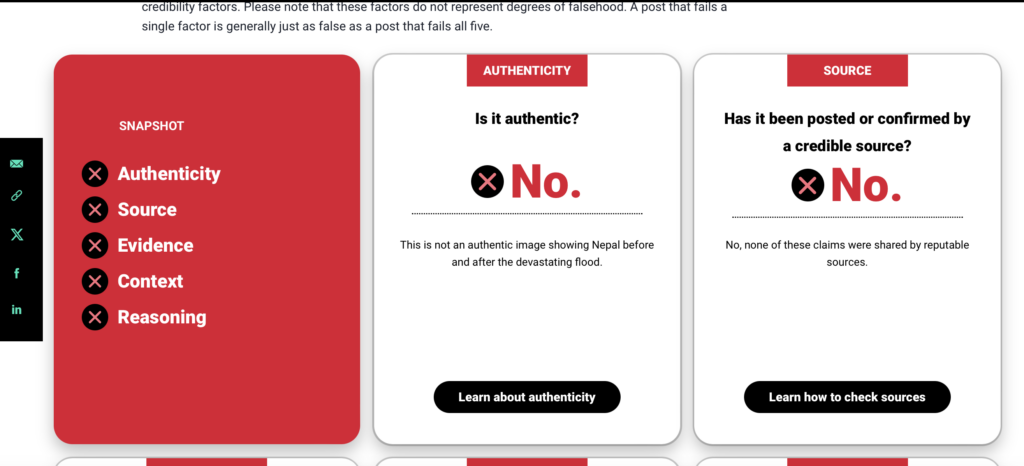
RumorGuard example showing the Authenticity and Source credibility checks.
I believe RumorGuard works well because it provides users with a straightforward checklist rather than requiring them to commit specific fact-checks to memory. All five criteria were not met by the example I looked at. The tool clarified that the material had been taken out of its original context, the image was not authentic, the claims were not supported by reliable sources, the evidence denied the claims, and the reasoning was unfounded. Because the same questions can be used for posts on TikTok, Instagram, X, and other platforms, this makes the lesson applicable. The method’s dependence on users slowing down long enough to look into a claim is a downside. People might react or share before doing that in a social media feed that moves quickly. Even so, RumorGuard provides a useful routine for becoming more skeptical without assuming that everything online is false.
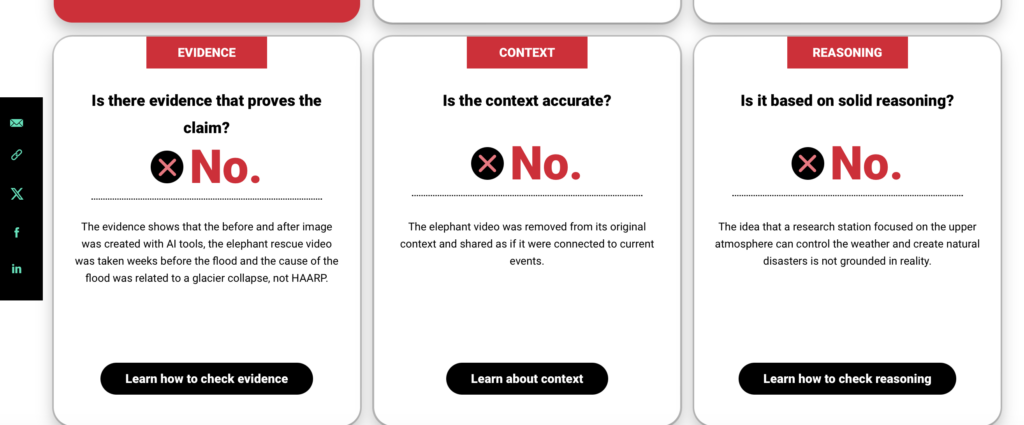
RumorGuard’s Evidence, Context, and Reasoning checks.
Resource: RumorGuard – About and How It Works
Bad News
The second tool I used was Bad News, a browser game that teaches misinformation from the opposite perspective. Rather than fact-checking other people’s content, the player creates fake news and seeks to attract followers while retaining enough credibility to retain viewers. Impersonation, emotional language, conflict, conspiracy theories, discrediting opponents, and trolling are the six common manipulation techniques taught in the game. Players make decisions and can see right away how those decisions impact credibility and followers.
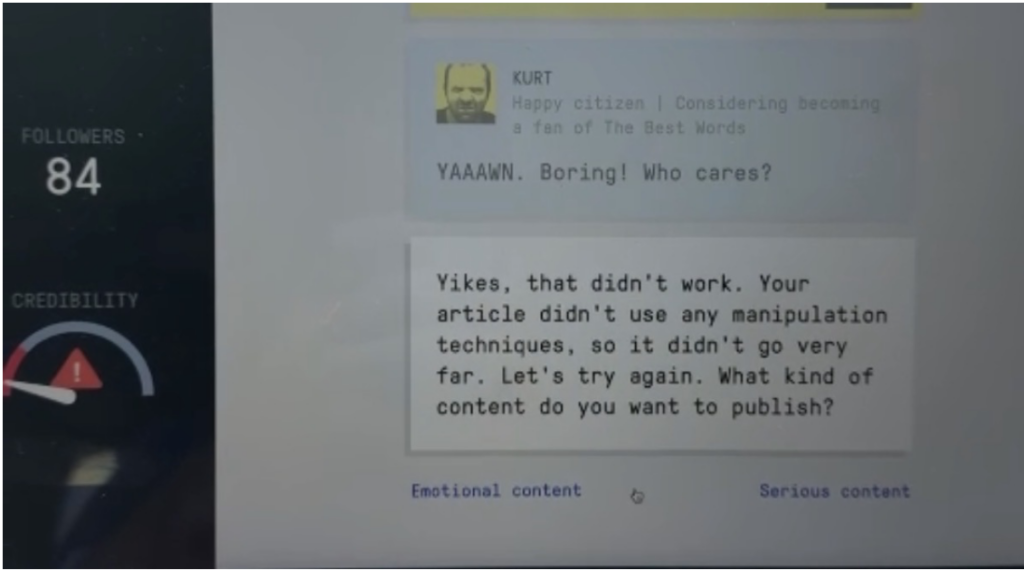
Bad News explaining that content without manipulation did not spread and offering an emotional-content strategy.
I found this approach especially effective because it shows why misinformation can spread rather than simply saying that it does. For example, after I chose content that did not use manipulation, the game told me that the article did not go very far and encouraged me to try emotional content. Later, the game explicitly said that conspiracy theories “really get the people going,” while my account had reached 4,475 followers. Seeing the follower count rise makes the incentive structure behind sensational misinformation much easier to understand.

Bad News demonstrating the conspiracy-theory strategy with 4,475 followers.
This kind of game-based approach is supported by research. With roughly 15,000 participants, Roozenbeek and van der Linden examined Bad News and discovered evidence that gaming enhanced people’s capacity to identify and fight off common misinformation tactics. The concept is comparable to psychological inoculation because exposing individuals to mild instances of manipulation can help with their later recognition of the tactics. I believe interactive tools and educational games are beneficial because they allow participants to practice skills rather than just read about them. Additionally, they are more interesting than a typical lecture. But games by themselves won’t get rid of false information. They are most effective when used in conjunction with fact-checking, responsible journalism, media literacy training, and improved user behavior prior to liking, believing, or sharing questionable material.
Resources: Play Bad News | Roozenbeek & van der Linden (2019) research study
Leave a Reply